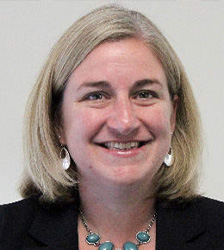
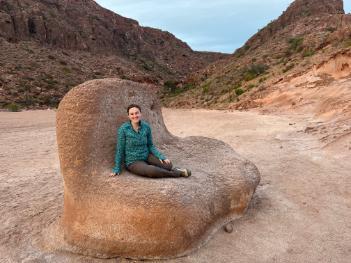
 Master Teacher Clare Gilroy was recently selected for the Ecology Project International (EPI) Fellowship, where she traveled to Baja Sur, Mexico in March to conduct research on coral reefs and learn about marine life.
Founded as a nonprofit organization in 2001, Ecology Project International creates positive long-term environmental impacts through its science education programs, conservation initiatives, and engagement with local communities and partners. The organization provides professional development programs through its teacher fellowships. Their programs provide training in progressive field-based science education, offer unique opportunities to work with wildlife, and connect participants to a growing network of educators.
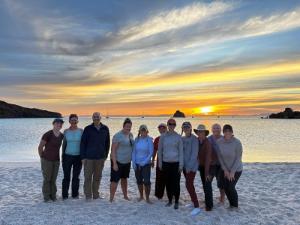 The program was a unique experience for Clare. As she reflects: “A major highlight was seeing such amazing biodiversity. From unique desert environments filled with cardon cacti to coral reefs teeming with balloon puffer fish and cortez damselfish, there was so much nature to take in. I even had the chance to swim with sealions and see a fin whale and her calf!”
Clare also notes how this experience has enhanced her teaching practice.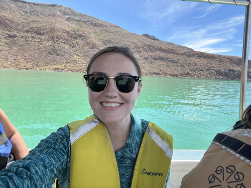 “All of this exposure to new environments helped me think of different phenomena to utilize as we re-work our curriculum to meet NYSLYSS. While I want students to understand ecology in their own environment, I also want them to be able to apply it to new scenarios in different places. Additionally, I learned some great questioning protocols that align with the science and engineering practices so I can better support my students.”
Learn more about Ecology Project International’s Teaching Fellowships
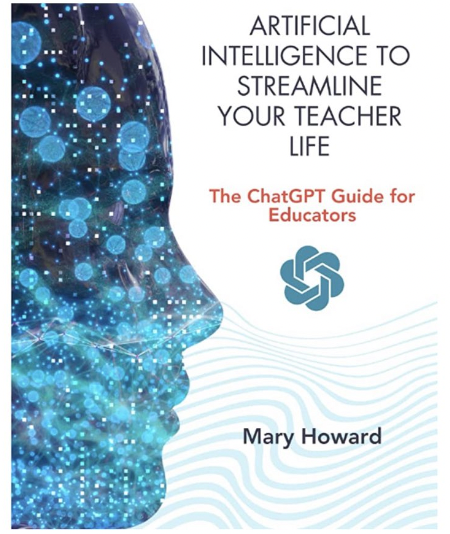 Master Teacher Mary Howard has recently published a terrific new resource book, “Artificial Intelligence to Streamline your Teacher Life”. The book is very aptly named, since it is a concise, easy to use guide to an exploding topic in Artificial Intelligence (AI) known as Chat GPT. ChatGPT is a chatbot that is trained to use natural language processing to create a conversational dialogue. The GPT means "Generative Pre-trained Transformer," which is how ChatGPT processes questions and formulates responses.
The book explores how to use effective prompting strategies to get useful results. What can you do with this technology? The bot can help you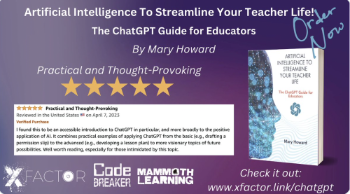 create lesson plans, align a lesson to standards, generate examples, and create grading rubrics. As Mary explains, there are some limitations. The bot was trained by humans, and so may reflect the inherent bias of the trainers. When you get a response, Mary cautions, “don’t just copy and paste, make sure to review the response for inaccuracies or implicit bias”.
Mary has always incorporated new technologies into her teaching, and when Chat GPT came on the scene, she jumped right on it. Her passion has always led her to “chase down” new tech tools whenever possible. Why did she want to write this book? She’s found so many ways that tech tools can support teachers and she wanted to share her discoveries with her colleagues. She notes that “ChatGPT can be helpful in the classroom and make many tasks easier, so perhaps it may help to streamline workloads and prevent teacher burnout in our profession”.
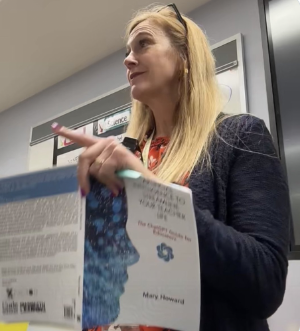 Tim Needles, Long Island Director of the NYS Association for Computers and Technologies in Education, shares that “What makes Mary’s book particularly valuable is the way she combines her educational knowledge of the behind-the-scenes work we do as educators and her experience with ChatGPT to facilitate uses for teachers at any level that might be new to the technology. In our world of ever-changing technologies in education, it’s helpful to have teachers like Mary Howard share their best practices…”.
For more information about the book please see the March/April 2023 STANYS newsletter for an article that Mary wrote on this topic or follow Mary’s blog. Mary will also be presenting her work this summer at the NYSMTP Summer Professional Development Conference hosted by SUNY Oneonta.
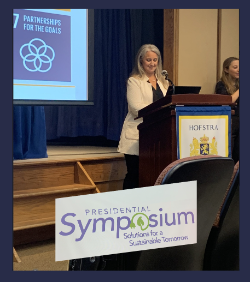 In the fall, Dr. Tornabene, who teaches in the Long Beach City School District, shared her experiences on a panel entitled “Climate Change Education in the Public Schools.” She discussed how teaching students about climate change is embedded in the NYS Science Learning Standards with the end goal of helping K-12 students develop agency for civic action around climate issues.
You can listen to Dr. Tornabene’s remarks at the 44:15 mark of the video. If you are looking for a vertical approach to this important topic, including many hands-on activities, watch the video. (Individuals who would like to contact Dr. Tornabene directly can email masterteacherprogram@suny.edu for assistance.)
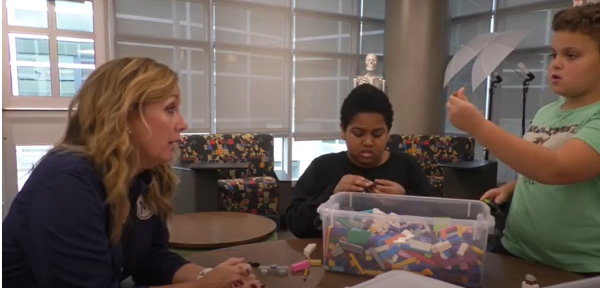
Kari Hettinger’s dedication to helping students learn about STEAM careers and hone their STEAM skills is featured in two Teacher Profile videos for the Owego-Apalachin Central School District.
Mrs. Hettinger was among the first four elementary teachers nominated for the Teacher Profile videos. She was invited to talk about her journey to teaching, what she loves about teaching, and share some highlights from her classroom.
An alum of SUNY Cortland, earning her BA in Elementary Education, African American Studies, and Studio and MSEd, Mrs. Hettinger teaches STEAM classes for students in grades K-5. Selected as a NYS Master Teacher in the winter of 2022, she began collaborating to design innovative STEAM projects with her fellow Master Teachers based at Binghamton University in the Southern Tier region.
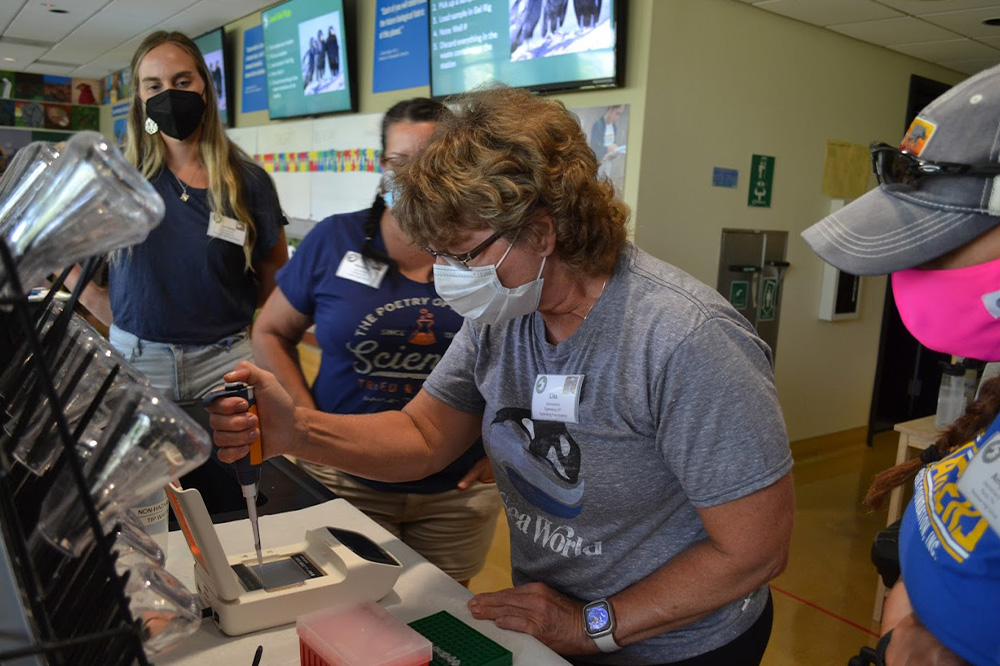
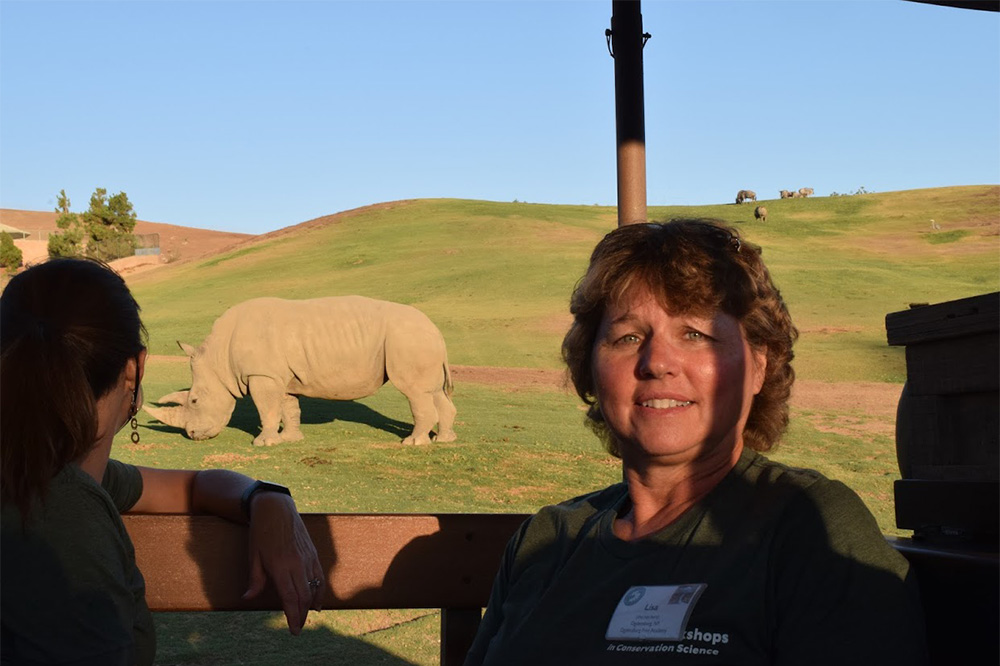
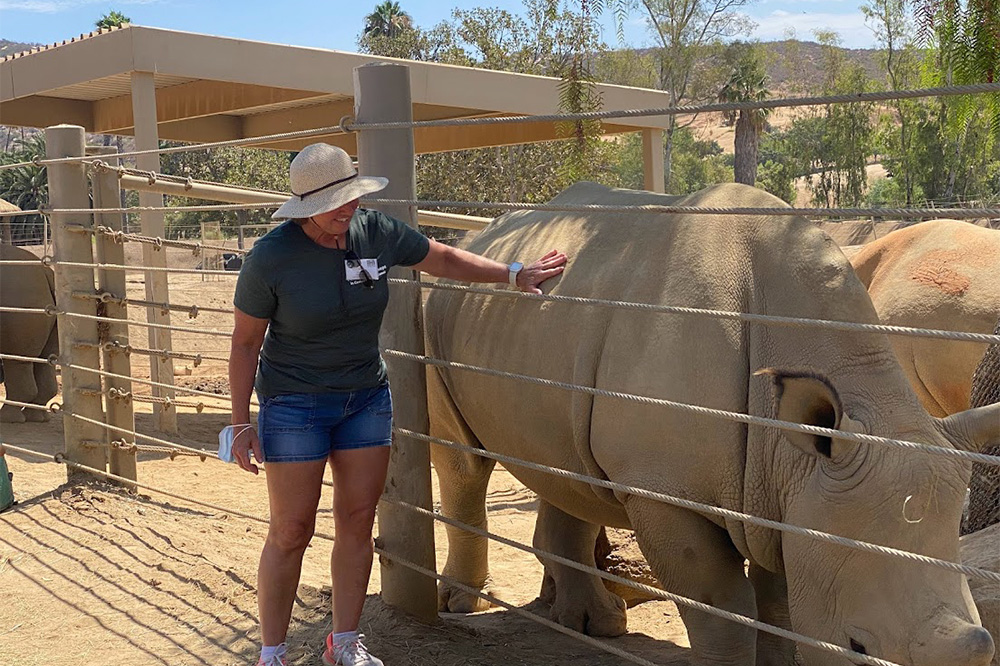
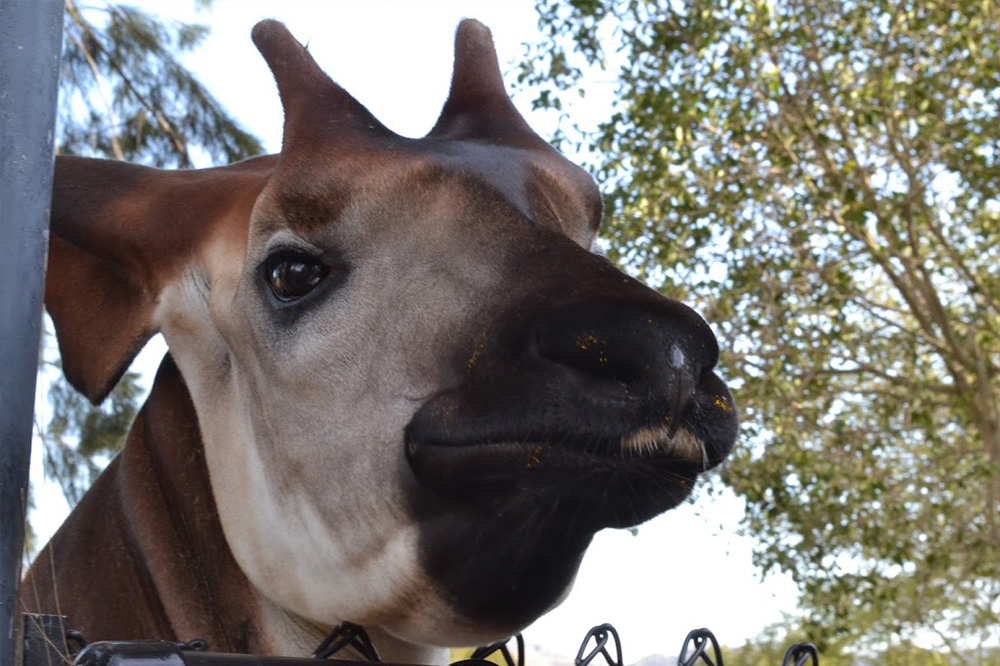
Congratulations, Lisa Beldock, on her acceptance to the Teacher Workshop in Conservation Science at the San Diego Zoo! Lisa shared that the program's main objective is to "connect science educators to wildlife conservation through relevant laboratory and field-based experiences that share recent advances in the San Diego Zoo Wildlife Alliance's conservation research."
Lisa was able to participate in several NGSS-aligned conservation science activities that she can use with her biology students in the rural Ogdensburg City School District. Lisa is a member of the North Country Master Teacher cohort based on SUNY Plattsburgh.
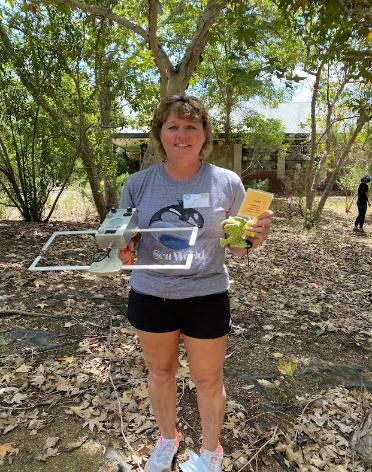
One of the activities that Lisa engaged in and will borrow equipment for her classroom is a California condor genetics exploration that involves "utilizing polymerase chain reaction and gel electrophoresis as tools to determine the sex of this sexually monomorphic species." She adds that "while waiting for the gel electrophoresis results, we learned how to use pedigrees to manage genetic disease and apply our knowledge to make recommendations for a mock managed care breeding program."
In addition to studying rhino reproductive endocrinology, polar bear energetics, and life in a biodiversity hotspot, Lisa and her colleagues used radio telemetry devices to develop their understanding of spatial ecology through a mountain yellow-legged frog spatial ecology unit in which they tracked a plush frog and collected and analyzed monitoring data for health status, behavior, and location. Through their ArcGIS data analysis, they were able to determine frog movement patterns and generate future research questions for a post- release monitoring study.
Lisa appreciated the opportunities she had to learn about the latest innovations in her field and to connect with other professionals from outside her my district and state. "Participating in this teacher workshop and in the MT program allows teachers to learn, network, share, create new ideas, and ignites motivation."
When she applied, Lisa did not even imagine that she would be accepted..."and thanks to my superintendent, Kevin Kendall, I was able to participate. "It was such an amazing opportunity to travel to California and work with teachers from across the country at the San Diego Safari Park. I never would have applied if it wasn't for the NYS Master Teacher Program. I am so thankful and appreciative to be in this program. It has opened up opportunities and experiences that I would not have encountered otherwise."
We, too, are grateful to all of the remarkable STEM Master Teachers who make participation in the NYSMTP such a powerful experience.
Congratulations to NYSMTP Master Teachers Emeritus Laura Westerman, Finger Lakes SUNY Geneseo cohort, and Jessica Mintz and Stephanie Burns, Long Island Stony Brook University cohort, on stepping into your new leadership roles!
Building on their distinguished careers in the classroom as STEM educators recognized as STEM leaders and as NYS Master Teachers, Laura, Jessica, and Stephanie have recently moved into positions as school and district leaders where they will have even greater opportunities to influence faculty and students throughout their schools and districts.
NYS Master Teachers are leaders in their schools, districts and among their peers. The NYSMTP is dedicated bringing engaging and innovative STEM educational experiences to all students in NYS. It is our privilege to support the NYS Master Teachers' growth as leaders.
 For several years, Mark Kaercher, and his wife, Jessica, a librarian, have hosted a book-lending library on their front lawn. Fast forward to winter 2021, Mark wondered about extending the Little Free Library concept to share his love of math with the community in a way that would broaden people's thinking about what math encompasses. Truth be told, he was hoping to shift thinking about "not being a math person", noting that all you really need is the willingness to explore and play.
The Tiny Math Studio is full of engaging puzzles, string art projects, origami activities, and math games. He has even set up a QR Code Guest Book and welcomes visitors' comments and questions.
Our house has hosted a Little Free Library for years now. Well today, I opened the Tiny Math Studio!!
— Mark Kaercher (@shskaercher) April 9, 2021
It's stocked with lots of mathy goodies, including Panda Squares from @MathHappensOrg, Zines from @Public_Math, origami projects, string-art kits and more. pic.twitter.com/vHeLjm0dlD
Through his work as a NYS Master Teacher and active member the Association of Mathematics Teachers of NYS, he has inspired teachers through his acclaimed presentations on topics such as paper folding that make deep mathematical concepts visually and physically accessible. Mr. Kaercher regularly returns to his alma mater, SUNY Plattsburgh, and leads workshops for the North Country cohort of Master Teachers, shares a wealth of teaching resources on his Twitter account, @shskaercher.
Visit his Twitter feed and you’ll surely start to think of yourself as “being a math person.”
September 2021

Congratulations to Long Island Master Teachers Mary Kroll, Robert Bolen, John Halloran on the honor of having their inspiring article, Collaboration Crushes Competition! Preparing High School Research Students for Success in Big Science Careers, published in "The Science Teacher," a National Science Teachers Association publication. "The Science Teacher" is an award-winning, peer-reviewed practitioner journal for secondary level and high school science teachers.
The article highlights the innovative work high school students enrolled in the Science Research course at Connetquot, West Islip and Eastport-South Manor Junior Senior High Schools are doing in partnership with Brookhaven National Laboratory (BNL) through the “Student Partnerships for Advanced Research and Knowledge” (SPARK) program, and the value of engaging students in collaborative research efforts utilizing high tech BNL resources and guidance by BNL scientists.
Mrs. Kroll, Mr. Bolen, and Mr. Halloran are strong proponents of authentic learning experiences for students. They write:
In recent years, there has been a gradual shift away from individual student research projects toward collaborative projects (where teams of students present group results and all share in rewards such as scholarships and prizes). The many advantages of collaborative work include improving the important social skills of better listening, avoiding negative judgments on new ideas, and valuing diverse input from students outside the specialized field of the experiment.
Read the full article at Collaboration Crushes Competition!
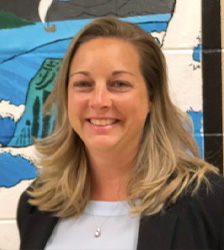
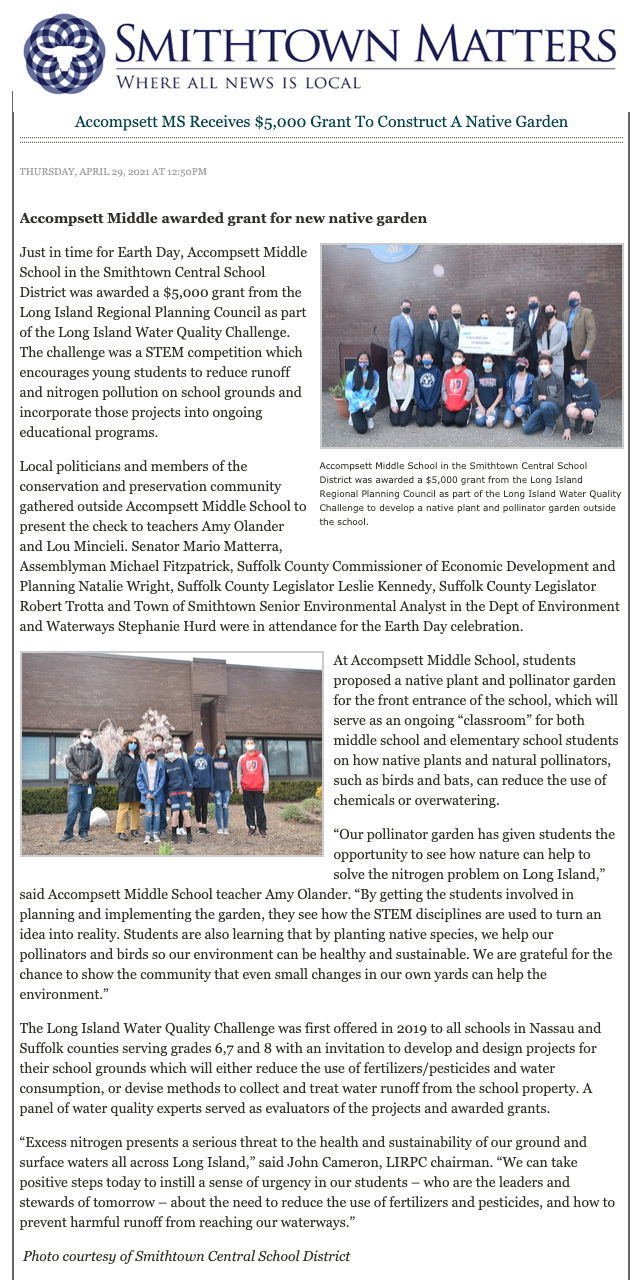
Congratulations to Amy Olander for receiving a $5000 grant from the Long Island Regional Planning Council to create a native plant garden on the Accompsett Middle School campus. This grant maybe have been a surprise but Mrs. Olander love of science is not new: She earned her BS in Environmental Science from Binghamton University.
This video features Mrs. Olander and her students working on plans for the garden and members of her science club spreading mulch.
Recently, Mrs. Olander participated in a Water Quality Challenge which evolved into this project. She shares that the grant "was enough to allow us to hire Seatuck Environmental Association to do a workshop with students in 2nd, 5th and 6th grades. In the presentation, students were taught about how native plants help our pollinators and birds, as well as our groundwater. They then were taught some basic design principles (color, height, when it blooms, who it helps) and learned info about 12 species of plants that would work for our garden." The Accompsett Middle School used their knowledge and skills to design the garden, and present their ideas to educators from the Seatuck Environmental Association.
The Accompsett Middle School in Smithtown on Long Island is on a campus shared by their elementary and high schools, making the garden accessible to K-12 students studying all disciplines. Mrs. Olander noted that, "Native gardens at schools are becoming popular.” There have been a number of Master Teacher professional learning opportunities dedicated to creating school gardens so we are sure the idea is growing…

Shine On! Program Selected to host NASA Downlink with International Space Station
North Country Master Teacher, Diana Danville, in partnership with SUNY Plattsburg's ShineOn Girls! program, was instrumental in setting up the “2021 ShineOn! Look to the Stars” conference, and connecting New York students with astronauts on the International Space Station for a chat and discussion of student questions.
Watch the video to hear some of the student questions and astronaut responses.
The video was created by SUNY Plattsburgh alumnus Scott Danville.
SUNY Plattsburgh alumna Mrs. Danville has been with Shine On! from the start and is dedicated to its mission.
🤔 Did you ever question being an astronaut?
— NASA STEM - Inspiring the #Artemis Generation (@NASASTEM) May 5, 2021
🤔 What is your favorite experiment?
🤔 What advice would you give your 8th-grade self?
Tune in to NASA TV tomorrow, May 6 at 10:30 am ET to watch @Astro_Megan & @Thom_astro answer questions from @ShineOnGirls! https://t.co/tO0VO45GCL pic.twitter.com/FDUtlTYAzE
April 9, 2021
Congratulations to Stony Brook-based Master Teacher AnnMarie Mills on securing a NOAA Planet Stewards grant to create habitats featuring native plants on Long Island’s Islip District Middle School grounds to increase biodiversity. Mrs. Mills credits her experience at the Greentree Foundation's Teacher's Ecology Workshop for her professional "metamorphosis". She writes that the workshop is a week-long workshop led by local environmentalists, scientists, and professors. The Greentree estate has one of the most beautiful native plant meadows on Long Island and they encourage educators to implement a native garden at their schools for both educational and environmental purposes.” Over the past seven years, several of her Islip colleagues have also attended the workshops and developed interest in creating a native garden and outdoor classroom.
In addition to funds to support the development of the garden, the project also entails support and collaboration with environmental experts. The Seatuck Environmental Association, a non-profit organization dedicated to conserving Long Island wildlife and environment, is coordinating the project and working with AnnMarie and her students all along the way. “This is a long-term partnership that has been many years in the making. I am thrilled to finally have an opportunity to establish a native garden at Islip Middle School, with the guidance of a local environmental agency, that will be enjoyed by the community for many years to come.”
Mrs. Mills is grateful for all of the local encouragement she has received. "I was fortunate to have the support of my administration and building principal...submitting the proposal despite the pandemic will be one of my most memorable professional achievements." We're certain that the experiences will be most memorable for everyone involved!
February 2, 2021
Master Teacher Chris Hurd and Indiana-based colleague, Jim Hanson, are on a mission. It is on the home page of their website: To make Computer Integrated Manufacturing [CIM] more exciting and easier for students and educators alike.
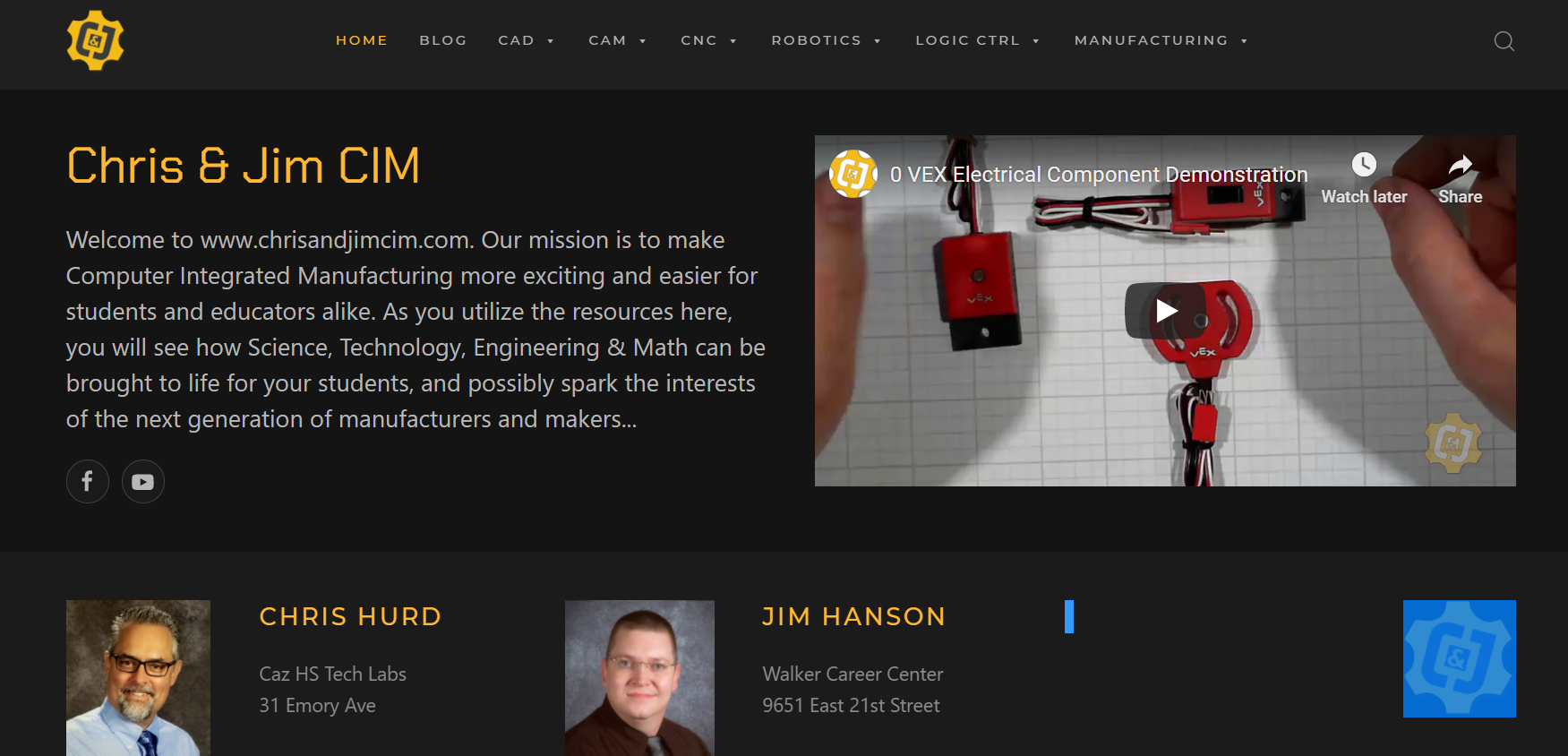 Over the last seven years this teacher collaboration has led to the creation of a website, http://chrisandjimcim.com, a place “where computer integrated manufacturing and high school education collide.”
After only two years, the website was recognized by Google Analytics as one of the top CIM education websites worldwide. In 2021, over 4 million visits demonstrate how teachers and students across NYS and the country regularly view and download the materials for their Computer Science, Engineering, Mathematics, and integrated STEM classes.
Cazenovia High School Principal Molly Hagan notes
Chris's website is one of the few that is made by teachers, for teachers, and that is one of the reasons it is so popular with others, not just locally, but nationwide. Chris regularly gets calls and emails from around the country regarding the resources they have shared and regularly helps others before and after school via phone and Zoom. Throughout the pandemic it has been used by students nationwide, as he and fellow NYS Master Teacher, Thuc Phan, have been posting their STEM lessons and resources on line as well.
 The website also includes a space for local industry leaders to talk about careers in manufacturing. Students based in the Central NY region will recognize the Marquardt Switches company that counts many Cazenovia School District graduates among its employees. Marquardt created an engaging video to dispel the “myths” about careers in manufacturing which is a must-watch for all students asking “why take advanced technology or computer science electives in high school?” Click on the manufacturing myths section of the website.
In a recent conversation, Chris shared a few recent updates to the website:
Chris credits his colleagues in the NYS Master Teacher Program for expanding the resource design to integrate all the STEM fields more deliberately. For example, they added a Math projects tab which includes a statistics-focused project that could be used in both math and engineering classrooms.
In the classroom for 31 years, Chris currently teaches Technology, Computer Science and Engineering courses in the Cazenovia Central School District. Jim has taught Engineering and technical courses for 21 years and is at the Walker Career Center in Indianapolis, Indiana.
Chris and his colleagues know firsthand how teacher time is limited and educators seek teacher-tested classroom resources that can be used in face-to-face and remote classrooms. Chris is passionate about sharing these resources on the website with as many teachers as possible and has leveraged the statewide network of NYS Master Teachers to help share the resources.
We agree with Principal Hagan: “It's great to know that this is homegrown right here in CNY, and we are proud to say it started in Cazenovia. Chris, as a veteran teacher, continues to bring new and innovative ideas to his instruction and his professional endeavors as a Master Teacher outside of school. His contributions to instruction, innovation, and leadership are highly valued in our district.”
November 17, 2020
Students in Mrs. Weinsztok’s science classes in the Westhill Central School District in Onondaga County rarely ask “When will I use this in real life?” because they are using what they learn to educate their families and community.
 Mrs. Weinsztok engages her classes in Project Based Learning, a teaching method in which students learn by actively engaging in real-world and personally meaningful projects.” Focusing projects on humanitarian issues, she challenges her Biology students to think critically about ways to address community issues in sustainable ways.
Relying on her expertise in classroom technology tools, her students us what they learn in class to address community issues with the community.
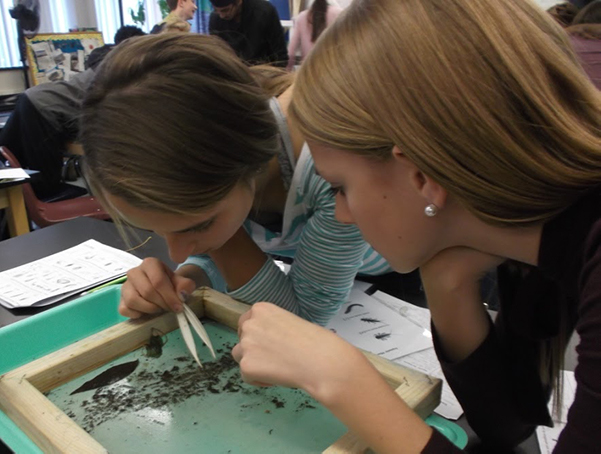 Tough on Ticks CNY was a project sparked by a spike in tick populations and number of cases of people infected with Lyme disease in the local community of Onondaga Hill. Students worked with representatives from the Cornell Cooperative Extension, spoke with Alicia Healy, who was featured in Syracuse.com to chronicle her battle with Lyme during her teen years, and an epidemiologist specializing in infectious diseases. They learned how to find and collect ticks, and best prevention methods, and created a resource for the community.
What do students think of this project? Hannah says “I appreciated the project because it gave me an opportunity to learn about ticks in a relevant, investigative, and collaborative way. We gained real-life skills by learning how to analyze, problem solve, and present solutions to an authentic audience made up of community members.” Liam noted “I appreciated that it got us out of the classroom and spend time outside to learn about our local ecosystem.”
Healing our Relationship with Onondaga Lake stemmed from a trip to the Ska-nonh Center, funded by a mini grant from SUNY College of Environmental Science and Forestry (ESF) and the ESF Center for Native Peoples and the Environment. Mrs. Weinsztok says that her “students were hooked with the opener: It all started with a breakup. The focus of the student work was healing a broken relationship, that of humans with Onondaga Lake. Students studied various topics concerning Onondaga Lake, its pollution, restoration efforts, and at the time, the building of the amphitheater.”
Karen Fenner, Library Media Specialist at Westhill High School, notes that the “district’s Board of Education goals center around providing authentic learning opportunities through inquiry-based instructional practice that encourages collaboration, risk-taking, and critical thinking with demonstrated evidence. Alaina's instructional practices epitomize this goal!”
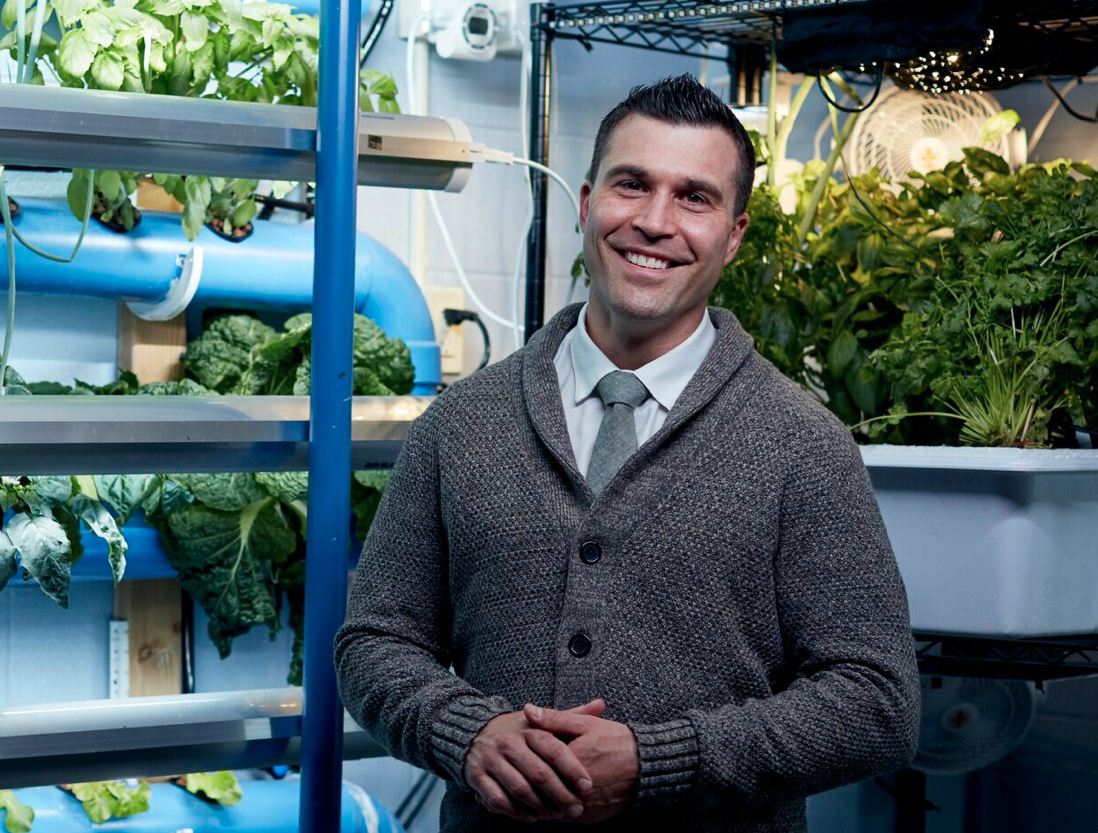
Long Island Master Teacher Chris Regini started his website ‘Reginius Science’ three years ago to celebrate the amazing work of the students in the Half Hollow Hills School district. As the 7th grade General Science, and High School Engineering teacher (as a part of the Project Lead the Way program), he incorporates inquiry-based projects to help students learn coding, robotics, aquaponics, engineering and agriculture.
Mr. Regini shares the impact of creating the on-line tool:
The website has been an excellent tool for recruiting programs to work alongside us. We have had a number of partnerships over the last couple of years centered around agriculture and sustainability, vertical farms and the incorporation of technology. Our coding endeavors have been with schools in other states within the US (MO, MD, OH, CA, and NJ). To date, we have had partnerships with schools in China, Mexico, Finland, New Zealand, Canada, and the UK.
The international collaborations included; cross cultural pen pal programs, the growth of new crops in their FarmBot, the comparison of different types of hydroponic systems and crops, and the development of ways to reduce our emissions through the calculation of carbon footprints of our school buildings. Mr. Regini’s students became teachers for the international peers, teaching them how to write a program within its farming software so that they could remotely watch their produce grow.
To prepare for the return to school, Mr. Regini updated the News Feed section to show families how his intuitive classroom set-up addressed social distancing and simultaneous remote and in-person instruction. Essential to Mr. Regini, was how all Half Hollow Hills students are able to participate by monitoring and collecting data as they study their class’ vertical hydroponic Mars Farm, soil-based FarmBot and aquaculture wall systems while at home or in class.
The website is also a resource for teachers who can view additional information about the extraordinary work he and his students achieve, sample lessons, updated news and more. Chris welcomes questions and feedback too. You can access the website at https://www.reginiusscience.com, and follow his students’ experiences on YouTube, Instagram, Twitter and Facebook.
9-18-20

What do you get when you combine a passion for math, a passion for teaching, and a passion for coding? When it’s an experienced math teacher in the Hilton Central School District, you get FishMath by Thomas Fisher.
 "I wanted an easy website for my students to remember so I combined Fish from my last name (Fisher) and Math from the subject I teach. I figured there was no way my students could forget it if it was that easy!" It began as a website with links for class and has evolved each year since. Mr. Fisher relies on his knowledge of computer coding to create problem generators to provide students with an endless supply of practice problems and answers to build their mathematical fluency.
Seven years on, the website has been quite successful. Algebra and Pre-Algebra students and their families use the extra practice problem generators and consider the videos really helpful to learn and review the math content at home. Other teachers have also shared that they use the website to help them create worksheets or other learning materials for their students.
Mr. Fisher is clear about an important aspect of the design: “Since everything is accessible for free (and always will be) anyone and everyone can use the resources.” He recently added a Graphing tool for students who do not have a graphing calculator at home.
FishMath, https://www.fishmath.com/, is a terrific resource for students, families and teachers. If you already visited the site, check back frequently as Mr. Fisher is creating new problem generators to ensure that every unit from 7th grade through Algebra I is included. He recently added proportional graphs and rate tables to the Proportional Reasoning unit and three new interactive tools, Integer chipboard, Algebra tiles, and Color Cubes, which are especially useful for students during hybrid learning. As you would expect from a professional like Mr. Fisher, he welcomes your feedback and ideas for further development. Contact him through the FishMath.