

6-22-26
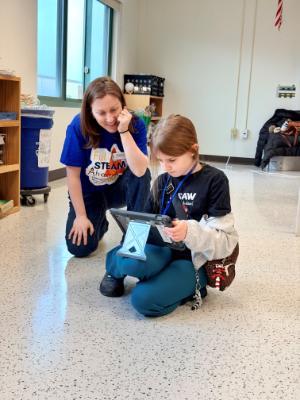
While the gender gap in STEM fields remains a global challenge, the Southern Tier region is taking a proactive, hands-on approach to changing the narrative. In March, the NYS Master Teacher Program (NYSMTP) hub at Binghamton University hosted "Full STEAM Ahead," a premiere community outreach event designed specifically for young women in grades 4–8. With 130 eager participants in attendance, the day was defined by intensive hands-on activities across Science, Technology, Engineering, Arts, and Mathematics, facilitated by the expertise of current and emeriti Master Teachers.
A Multigenerational Mission: Keeping Science Alive
The event was marked by a unique passing of the torch, highlighting the long-standing impact of the NYSMTP. Julia Fiato, a current Master Teacher in the Binghamton City School District and one of the event’s lead organizers, was inspired to bring a girls-focused STEAM event back to the region after hearing "wonderful things" about previous iterations from her mother. That mother is Patti Fiato, a Master Teacher Emeritus who recently retired after a distinguished 32-year career in elementary education. Together, the mother-daughter duo stood at the registration table, embodying the program’s commitment to mentorship. Both Julia and Patti stressed the vital importance of keeping science alive in the classroom at an early age. For Julia, the event was about more than just one day; it was about honoring the legacy of educators like her mother while creating a modern space where young girls feel "comfortable stepping out of their comfort zones" to explore complex STEM disciplines.
Student Voices: From Theory to Tangible Creation
The impact of this approach was best captured in the words of the participants themselves, who moved beyond textbooks to engage with the mechanics of the modern world. In sessions like "Molecular Mixology," students explored the chemistry behind food science, with one participant noting that learning "how popping boba even has science involved" sparked a new curiosity about the world around her. The engineering sessions provided a direct link between imagination and execution. Whether it was the "3D Pen Creations" workshop or the "Lego Robotics" challenge, students reported a shift in how they viewed their own capabilities. "Using the 3D pen made me more interested in building things," one student shared, while another noted that "coding in the Lego thing made me wonder how coding works." For many, the highlight was the kinetic reward of the "Force and Motion" sessions: "When we were building cars, I liked putting together parts and watching it move." These reflections underscore the event's primary goal: proving that science is not just a subject, but a fun, creative process of making your own "builds."
STEM Content and Collaborative Innovation
The event served as a practical application of the NYSMTP’s commitment to deepen the knowledge of STEM content for educators. For the facilitators, this event was the culmination of over a year of strategic planning. Amy Finley, of the Deposit Central School District, shared that the event was a "long time coming," noting that she was one of the original members who brainstormed the concept during a workshop in the previous program year. She highlighted the value of targeting this specific age group to grow student interest by providing high-level STEM learning opportunities that exist outside the traditional classroom walls.
Pedagogy: Making Science Engaging
A core pillar of the day was the knowledge of pedagogy, where Master Teachers refined their practice to ensure every session was impactful. Molly Russell, of the Vestal Central School District, one of the event organizers, emphasized the intentionality behind the program's design, noting that the team worked tirelessly to create an organized environment where girls felt comfortable. She explained that the team even planned the transition minutes between sessions to decrease feelings of shyness, ensuring students were mentally prepared to learn new things from the moment they stepped on campus. Christie Kelly of the Broome-Delaware-Tioga BOCES, echoed this focus on effective instruction, observing that the facilitators succeeded in making complex STEAM content accessible through engaging, hands-on opportunities that ran seamlessly throughout the day.
Connecting with Students, Families, and Community
Perhaps the most significant impact was found in the connection educators were able to make with the participants and their families. By focusing on a female-only cohort, the Southern Tier Master Teachers addressed the specific challenge of increasing opportunities for underrepresented populations. Christie Kelly, reflected that the work strongly supported the connection between local educators and the families they serve, noting that the community's response was overwhelmingly positive. Families were already inquiring about next year’s date before the day was even over, a testament to how the program informs regional needs. As the day concluded, it was clear that "Full STEAM Ahead" had successfully moved beyond the classroom to build a stronger, more inclusive STEAM community in the Southern Tier.