X

Find Degrees for Agriculture Careers at SUNY

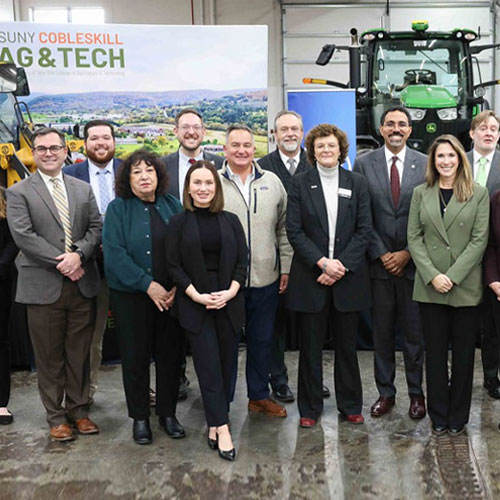
Agriculture powers New York State. The agriculture industry in New York is foundational in sustaining the state's economy, environment, and food systems.

If you're considering a career in agriculture, the State University of New York offers a wide variety of degree programs to get you started in the industry – all at a low SUNY tuition.

Did you know...?

Vector icon of a farm and trees.

30,650
Farms statewide

Vector icon of a sunset over a field.

21.6%
Of the state's area is farmland

Vector icon of a shovel and plant in ground.

165,000
Farming and related jobs in New York

SUNY’s Programs Prepare Students for a Career in Agriculture Across the Field.

Across 64 colleges and universities in New York, including specialized colleges of agriculture and technology, SUNY programs blend classroom learning with hands-on experience and real-world immersion to prepare students for a wide variety of careers in agriculture.

Join the next generation of agricultural, environmental science and policy leaders. Help improve the health of the community, nature, animals, and the planet.


Start a career in:

  • Farming
  • Food Systems
  • Forestry
  • Veterinary Science/Animal Care
  • Environmental Science
  • Sustainability/Conservation
  • Viticulture and Wine Technology
  • Businesses Management
  • Tourism
  • And more

Find Agriculture and Conservation Programs at SUNY

Filter Programs
Reset Results
 
Agribusiness Management
Degree Level: Bachelor's

This bachelor's degree provides students with the skills to make local agriculture economically viable through the application of traditional production practices, as well as the development of value-added products. This program prepares graduates to be successful in their efforts to improve the profitability of an existing farm or start a new agricultural venture. Students take production courses to build a strong foundation in agriculture, value-added courses to develop non-traditional agriculture skills, and business courses to understand marketing and financial management.

Degree Level: Bachelor's

Through this program, students combine knowledge of production agriculture with business and management skills. A full-semester internship enables them to mesh their skills and course learning through supervised fieldwork in a selected agriculture business or agriculture service organization. Graduates are prepared to own or manage a wide range of agricultural businesses.

Agricultural & Food Studies
Degree Level: Certificate

This certificate program combines hands-on experience and classroom instruction. Students take courses in microbiology, ecology, and sustainability. In addition, students will develop leadership skills in management, communication, and computer courses.

Agricultural Automation and Robotics
Degree Level: Associate

Careers related to agriculture are diverse and constantly changing. Today's students need the flexibility to tailor a degree to suit their needs. That's why our agricultural automation and robotics curriculum has been designed to prepare students to enter the workforce as an agricultural automation technician or continue their education in one of Alfred State's baccalaureate programs.

Agricultural Business
Degree Level: Associate

This degree program prepares students for leadership roles in the field of farm and food systems. Students will study a combination of business and science topics to support their success in the rapidly expanding economies of small farms, niche growers and specialty producers. In addition, each student will complete an internship in agricultural business to reinforce classroom concepts with real-world applications. Graduates will be prepared to start an agricultural business, manage a workforce in an agriculture-related field or transfer to a 4-year program in a compatible field.

Agricultural Business Management (BS)
Degree Level: Bachelor's

This broad-based program provides flexibility for students to custom design a unique educational experience, yet retains an essential knowledge base to ensure successful attainment of long-term goals. These goals may include graduate study, agribusiness employment, or self-employment. Agribusiness activity ranges from providing supplies and services to farmers through the actual on-farm production of food and fiber, to the processing and distribution of those products. In addition to these career paths, graduates also find careers in agricultural education, agricultural policy and advocacy, agricultural communications, marketing and economic development.

Agricultural Business Management (BT)
Degree Level: Bachelor's

This broad-based program provides flexibility for students to custom design a unique educational experience, yet retains an essential knowledge base to ensure successful attainment of long-term goals. These goals may include graduate study, agribusiness employment, or self-employment. Agribusiness activity ranges from providing supplies and services to farmers through the actual on-farm production of food and fiber, to the processing and distribution of those products. In addition to these career paths, graduates also find careers in agricultural education, agricultural policy and advocacy, agricultural communications, marketing and economic development.

Agricultural Communications
Degree Level: Bachelor's

This program prepares students for a wide variety of professions in the agricultural and food systems industry. It combines technical skills in graphic design with foundational and advanced courses in communications and agriculture. Coursework is focused on digital media, web design, interpersonal and intercultural communications, journalism, food systems, marketing, promotions, and sales of agricultural products, as well as agriculture policy, law, ethics, and leadership. Flexibility with upper-level course selection is available for students wishing to focus on one specific field within the program.

Agricultural Mechanics
Degree Level: Certificate

This 24-credit, one-year certificate program prepares students to become setup and repair technicians, farm mechanics, and small engine mechanics.

Agricultural Science
Degree Level: Associate

Students in this program acquire working knowledge of business management principles - as they apply to agriculture - that translate into vital competencies for careers in agribusiness. They also recognize the scope of the entire agricultural business system and the function of enterprises within the system, as well as develop an understanding of the theoretical economic framework and real-world markets in which all agribusinesses operate.

Degree Level: Bachelor's

This interdisciplinary program enables students to pursue a general education in agriculture to prepare for careers that require a scientific and integrated understanding of agriculture and food systems. They learn about agricultural sustainability from multiple perspectives by taking a wide breadth of core coursework, complemented by a concentration. All students are required to complete an internship for credit.

Degree Level: Associate

This program offers students four options that blend science and technology for employment in animal science, general transfer, agronomy, and agricultural technology. The animal science option is a perfect fit for students interested in the equine or dairy industry, or in a pre-veterinary program. Through the general transfer option students can take elective courses to build a solid foundation before pursuing further study in agricultural education, cooperative extension, plant sciences, pre-veterinary studies, or general agriculture.

Degree Level: Bachelor's

This program exposes students to a wide breadth of courses within agriculture and is comprised of four tracks: Agronomy; Agricultural Outreach and Education; Dairy Management; and Livestock Management. These tracks enable students to tailor their degree programs to their individual needs and graduates complete a set of core courses common across the four tracks. Graduates secure employment in a wide array of agricultural specialties, including the agricultural service sector, on-farm management of dairy and other livestock species, and in the public sector as agricultural educators. The Agricultural Outreach and Education track prepares graduates - upon completion of the degree - for an education master's degree.

Agriculture: Animal Industry
Degree Level: Associate

Students in this program become familiar with the basic care, handling and management of animals, as well as their nutritional needs. They learn to analyze and develop animal rations, research and present animal science information, communicate effectively, and work successfully with a team.

Agriculture: Animal and Plant Sciences
Degree Level: Associate

This two-year program provides students with the flexibility to tailor an associate degree, with elective courses, to fit their career goals. They choose from concentrations of courses in animal science to enhance knowledge of animal agriculture and/or dairy science, or fruit and vegetable production, to enhance their knowledge of crops and plant sciences.

Animal Care Assistant
Degree Level: Certificate

This certificate program provides students with hands-on skills for work in the animal care field. It also prepares students to be applicants for a veterinary technician or another animal care-related academic program (such as Alfred State's Veterinary Technician AAS program).

Animal Science Office Assistant
Degree Level: Certificate

This program provides students with training necessary to become animal science office assistants. Upon completion of the program, they demonstrate basic knowledge of animal nutrition, anatomy and physiology, infectious disease, medical terminology, and possess office skills necessary for the maintenance of a veterinary practice.

Animal Science: Beef & Livestock Studies
Degree Level: Associate

This degree provides a solid base in the production and marketing of meat animals in the Northeast. Students gain hands-on experience in handling various livestock using the year-round maintained breeding and market animal resources in the herds/flocks of beef, sheep, meat goats and swine, and seasonally with rabbits and poultry. Applied knowledge related to care and management, feeding, breeding, selection, evaluations, marketing and meat animal processing through the College's USDA Meats Processing Facility are highlights of major field courses.

Animal Science: Dairy
Degree Level: Associate

This program concentrates on dairy cattle management, with emphasis on both managerial and hands-on experiences. It leads to career opportunities in dairy nutrition or production management, reproductive management, and agribusiness. Graduates seek employment in the dairy industry, work at their family farm, enter the BTech program in Dairy Management, or transfer to other colleges.

Animal Science: Dairy Production & Management
Degree Level: Associate

Through this degree, students gain necessary skills, knowledge and experience via classroom instruction, laboratory training, on-farm experience, and field visits. They will be prepared to continue their education in bachelor's degree programs, or enter certain dairy-related occupations directly after graduation.

Animal Science: Equine Science & Management
Degree Level: Associate

- Description Coming Soon -

Animal Science: Equine Studies
Degree Level: Associate

This program is the oldest curriculum of its kind in New York State. It has been successfully training students to work in the fields of equine care management and related agribusinesses for more than 40 years. Opportunities for graduates are excellent and varied.

Animal Sciences
Degree Level: Bachelor's

This program offers an opportunity to apply animal biology, biochemistry, molecular biology, and other life sciences to the study of animal breeding and genetics, nutrition, physiology, growth, behavior, and management. The curriculum can be applied to a great variety of species, from farm animals and pets to laboratory animals and even some exotics. Students are encouraged, with the help of a faculty advisor, to plan an individual curriculum that suits their interests and career goals. The animal science major provides excellent preparation for students who wish to find positions immediately upon graduation, as well as those (approximately one-third) who plan to enter graduate or professional schools to obtain advanced degrees.

Aquaculture & Aquatic Science
Degree Level: Associate

Through its diversity and depth, this program prepares students for success in aquaculture, marine biology, fisheries and conservation, and many related industries. Students explore diverse subjects through practical, hands-on experience in a state-of-the-art aquaculture complex and wide assortment of laboratory and field settings. A feature of the program is the Controlled Environment Agriculture (CEA) initiative, a closed system which supports indoor plant cultivation and fish culture.

Aquatic & Fisheries Science
Degree Level: Bachelor's

Students considering a career in aquatic and fisheries science need a solid foundation of basic sciences combined with a broad training in organismal biology, ecology, and evolution. Upper-division courses focus more specifically on aquatic systems and fishes. ESF's many field stations provide important opportunities for field-oriented studies.

Canine Training and Management
Degree Level: Bachelor's

This BTech degree provides students with in-depth study and skills to successfully train and manage dogs. Subjects of study include biology, anatomy, training, behavior, management, health, genetics, nutrition, and physiology. The range and depth of course work enables graduates to directly enter the field of canine training and management or to pursue graduate studies.

Cannabis Careers
Degree Level: Certificate
Options: Online

This certificate program provides students with an informational foundation of the most prolific sectors within the cannabis industry: cultivation, processing, and retail. Students learn about the cultural and social history of cannabis use and the industry as a whole, and receive an introduction to cultivation, processing, and retail.

Cannabis Production and Management
Degree Level: Certificate
Options: Online

This 24-credit online certificate program prepares students for new and emerging roles in the legal medical and recreational marijuana industry. Graduates secure employment in plant cultivation, as budtenders, dispensary technicians, product managers, and marketing and sales associates.

Environment and Sustainability
Environmental & Natural Resources Management
Degree Level: Bachelor's

This program features a strong curriculum that blends the planning and adaptive management of renewable resources with business and communications courses. Its unique 15-credit, 600-hour internship requirement provides students with invaluable experience and professional contacts. Graduates secure employment in planning and managing natural resources conservation, soil and water conservation, environmental science, environmental technology, wetland management, and aquaculture and aquatic science.

Environmental Biology
Degree Level: Associate

This program prepares students for transfer to a BS degree in environmental biology or a related field. It combines classroom, laboratory, and field study instruction for well-rounded preparation. Students work closely with their academic advisor to determine choice of electives to ensure articulation with specific transfer colleges. Upon completion of a bachelor's degree, career opportunities include natural resource specialist, field biologist, environmental health technician, fisheries technician, and forest ranger.

Environmental Conservation Science
Degree Level: Associate

Primarily a transfer curriculum, this program features a rich foundation in the biological sciences, chemistry, and physics. Students take introductory courses in environmental technology and natural resources and select from an array of diverse electives such as aquaculture, arboriculture, silviculture, fish and wildlife management, surveying, and ecology. Graduates seamlessly transition to the BTech program in environmental and natural resource management, or to other bachelor's degree programs.

Environmental Education & Interpretation
Degree Level: Bachelor's

This program teaches people of all ages about the natural environment, so that they can make informed decisions on how to care for it. It integrates training in organismal biology, including a required field component, with in-depth training in the literature and context of natural history and a suite of environmental interpretation offerings. Students gain work experiences through a professional internship.

Environmental Management
Degree Level: Bachelor's

This BTech degree builds on the associate degree in Environmental Studies and trains students in the conservation of natural or biological resources, applied water resources, and ecosystem management and restoration. Courses emphasizing hands-on learning in soil and water conservation, watershed management, conservation biology, restoration ecology, forest and aquatic ecology, terrestrial invertebrate ecology, and applied hydrology form the core of the coursework in the program. Instruction takes place in the classroom, as well as outdoors in the forests, streams and rivers and on agricultural lands close to campus. Throughout the curriculum, current environmental issues - such as invasive species, climate change, habitat loss and conservation of biodiversity - are addressed and explored. Central to the program is a project-based capstone sequence that focuses on professional development, research methodology, proposal development, data collection, analysis, and presentation. Additionally, all students will be required to complete an approved professional experience consisting of an internship, co-op, or other similar experience.

Environmental Planning and Management
Degree Level: Bachelor's

This program emphasizes human dimensions in managing natural resources, along with technical skills in mapping science and geographic information systems. Graduates are employed by environmental consulting firms and work with both government and industry in the areas of environmental regulation and compliance. Others work with environmental advocacy groups to conserve and protect natural environments.

Environmental Science
Degree Level: Associate

This program is for students interested in environmental issues, sustainability, and the effects of climate change on the environment. Designed for seamless transfer to Bachelor of Science degree programs in Environmental Science at SUNY four-year colleges and universities, most credits are transferable to BS degree programs in biology, chemistry or environmental science at other colleges or universities. Graduates secure employment in state/local resource conservation agencies, the tourism industry for tourist activity monitoring and education, and in industries seeking experience in biological and chemical laboratory procedures.

Degree Level: Associate

The S.T.E.M. – Environmental Science Associate in Science major is intended to appeal to a broad audience of students who are interested in four-year degrees in the Environmental Sciences. This program meets the college’s mission by providing a University parallel degree for students aspiring to baccalaureate degrees and professions. The program also meets the college’s mission by fulfilling a broad range of General Education Requirements (GERs) intended to “broaden and deepen students’ intellectual, moral, civic, and social competence for effective participation in the world community.” Lastly, the program provides career advising, skills, and knowledge assessment related to jobs and programs that fall under the umbrella of environmental sciences.

Degree Level: Bachelor's

This interdisciplinary program draws from physical, chemical, and biological aspects of the environment and environmental systems. Students may select from a wide selection of courses, as well as high-quality internships and field experiences. Graduates are prepared to encounter a great (and increasing) demand for scientists with quantitative, interdisciplinary training in environmental sciences to address, mitigate, and manage many complex environmental problems facing society.

Degree Level: Associate

Students in this program develop a strong foundation in the sciences with courses in environmental science, ecology, geology, biology, and chemistry. Specialized courses in environmental science technology and environmental issues emphasize scientific project management skills and career pathways for environmental scientists. In addition to meeting other basic general education requirements (typical of the first two years of a BS degree), specialized environmental coursework provides students with a skill set useful for future employment in environmental engineering and remediation, resource management, or wastewater/drinking water treatment industries.

Degree Level: Bachelor's

This interdisciplinary program is administered by the Department of Geology and focuses on the environmental aspects of geology and chemistry. Through formal courses, laboratories, and research projects, students develop an awareness of the geological and chemical processes that impact society and the environment.

Degree Level: Bachelor's

This interdisciplinary program provides students with knowledge and skills to understand the complex interactions between the biological, chemical, and physical aspects of the natural world - using the Earth Systems Science approach. It includes 30 credits of foundational (cognate) math and science courses, 29 credits of core classes that focus on the Earth's major systems (air, water, soil, life, and solid earth), and a minimum of 14 credits of electives. Students with specific interests can explore them via a concentration (14-15 credits), a minor (generally 16-18 credits), or a double major (generally 30-45 credits) in closely allied fields.

Degree Level: Associate

This program integrates biological and physical sciences, including biology, chemistry, and physics. It serves students wishing to study environmental issues and work toward developing better solutions.

Degree Level: Associate

Through this program, students establish a foundation of biological, environmental, political and social sciences, as well as mathematics. They receive a thorough understanding of concepts associated with sustainability, global climate change, ecosystem protection, natural resource management, and environmental policy and protection. Graduates are prepared for transfer to environmental science BA or BS programs.

Environmental Science (Biophysical Track)
Degree Level: Associate

This program provides fundamental math and science preparation, knowledge of current environmental issues, and hands-on experience in natural resource management. Through classroom and field study, students are prepared for entrance into a baccalaureate degree program. Courses are offered in fish and wildlife, environmental conservation, terrestrial and aquatic ecology, field botany, limnology, wildlife management, and other science and natural resource-related subjects.

Environmental Sciences
Degree Level: Bachelor's

This program incorporates the strengths of outstanding programs in biology, chemistry, and Geosciences to understand the Earth ecosystem as a whole. The program emphasizes field experiences where students collect environmental samples, analyze them, and produce comprehensive interpretations of the data. Students demonstrate their ability to conduct independent work in the environmental sciences through internships with local conservation departments, consulting firms or municipalities, or through research with a faculty member.

Environmental Studies
Degree Level: Bachelor's

Through this program, students develop a holistic understanding of the Earth's environmental systems and how they interface with human society. The curriculum includes foundational coursework in biology, chemistry, physics, and mathematics and statistics, as well as atmospheric and environmental science to provide tools for understanding environmental systems. This is complemented with coursework in other disciplines to contextualize environmental issues by approaching them from a geographic, planning, cultural, ethical, historical, political, and/or economic perspective. Toward the end of the program, students take coursework that leverages interdisciplinary approaches to analyze complex environmental issues. Students are also encouraged to enrich their education through research and internships.

Degree Level: Bachelor's

Designed for students who find the environmental perspective compelling, Environmental Studies is a field that studies how human society intersects with the natural environment. This major encompasses the study of the natural and social sciences in order to understand environmental problems and processes. Fieldwork and internships are a required part of the curriculum. Specialty tracks provide a body of course work and experiences that prepare a student for a defined area within the field of environmental studies.

Degree Level: Associate

This program is designed for students wishing to transfer and continue their studies toward a bachelor's degree in environmental studies, or in related fields such as wildlife management, resources management, conservation biology, or environmental science. This is an interdisciplinary program that provides broad environmental literacy and a solid foundation for exploring the diverse environmental education and career opportunities.

Degree Level: Bachelor's

- Description Coming Soon -

Degree Level: Associate

This program engages students in the dialogues and the broader issues around environmental policies, economic development, land management practices, and responses to climate change. Students study these topics within the Adirondacks, where they affect residents on a daily basis.

Degree Level: Bachelor's

This interdisciplinary program applies tools of history and social sciences to interpret relationships between society and the environment. Students pursue careers in environmental education, international cooperation, journalism, consulting, and policy design, as well as analysis in governmental, non-governmental, or private organizations. They are also prepared for graduate study in a variety of environment-related fields.

Degree Level: Associate

Through this program, students establish a foundation of biological, environmental, political and social sciences, as well as mathematics. They receive a thorough understanding of concepts associated with sustainability, global climate change, ecosystem protection, natural resource management, and environmental policy and protection. Graduates are prepared for transfer to environmental science BA or BS programs.

Environmental Sustainability
Degree Level: Bachelor's

This interdisciplinary program encompasses the study of natural sciences, social sciences, and humanities to understand environmental problems and processes. It prepares students for careers in a wide range of government, non-profit, and business organizations that work to reduce human impact on the environment through the development of social, economic, and environmental values.

Degree Level: Bachelor's

This interdisciplinary program prepares students to collaboratively and creatively develop solutions to the pressing challenges the world faces in dealing with global climate change, loss of biodiversity, resource consumption and depletion, toxic pollutants and water shortages. Students also learn about issues related to environmental justice, creating sustainable cities, sustainable food, and transportation systems.

Environmental and Sustainability Sciences
Degree Level: Bachelor's

This program prepares students during their first and sophomore years to pursue a concentration in depth. The cross-college Environment and Sustainability undergraduate major is available in both the College of Agriculture & Life Sciences and the College of Arts & Sciences.

Equine Science
Degree Level: Bachelor's

This program enables students to work in many equine careers with courses concentrating on horse breeding, training, nutrition, and management. Students may specialize in one of five concentrations: equine science and management (hunt seat, western, or draft concentration); breeding management; racing management (harness racing or thoroughbred racing); equine rehabilitation and therapy; or equine business management. A semester-long industry experience takes place in the final year.

Fish and Wildlife Technology
Degree Level: Associate

This two-year program gives students hands-on experience with wildlife, which includes small mammal trapping, bird banding, and amphibian surveys. Non-invasive wildlife work includes camera trap studies, track identification, and bird surveys.

Fisheries & Wildlife Technology
Degree Level: Associate

This degree utilizes the classroom - and the world beyond it - to give students the richest possible educational experiences in this unique and important field. Through courses in fisheries techniques, hatchery management, and fisheries science, students receive hands-on, field-based training that is essential to their professional career, as well as prepares them for pursuing a bachelor's degree.

Fisheries and Aquaculture
Degree Level: Bachelor's

This program provides hands-on, field-based training in fisheries techniques, hatchery management, and fisheries science. Graduates embark on careers and/or pursue graduate degrees.

Food Science
Degree Level: Associate

This program focuses on the knowledge, skills and practical hands-on training needed for work in the food science, fermentation science, or brewing industry. It has a heavy concentration of courses in food chemistry, fermentation science, unit operations, brewing, distilling, food processing, and food and beverage analysis. Graduates secure employment as technicians in the brewing, distilling, and dairy food industry. Employers include breweries, distilleries, wineries, cheese makers, yogurt companies, food processors, ingredient manufacturers, government, foodservice, and testing laboratories.

Degree Level: Bachelor's

This program prepares students for leadership positions in the food industry, academia, and government. The research programs are designed to expand understanding of the biological/microbiological, chemical, physical, sensory, nutritional and engineering properties of foods and beverages. The extension and outreach programs transfer research-based information and technology to consumers, food and beverage companies and government agencies with the goal of enhancing the availability, quality and safety of our food supply.

Food Systems & Technology
Degree Level: Bachelor's

This Bachelor of Technology (B.T.) program prepares students for employment in domestic and/or international food systems. They learn about various food system designs, as well as critical technologies to efficiently and effectively produce, process, and distribute food. Food systems education is, by its nature, multidisciplinary. The design and implementation of a food system directly impacts diet, risk of food borne illness, economic development, business viability, air and water quality, and the capacity of resources to feed and fuel growing populations.

Forest Ecosystem Science
Degree Level: Bachelor's

This program combines professional competency in forest management skills with an enhanced understanding of ecological sciences. The curriculum consists of two broad categories of courses. The first is general education, which provides students with knowledge and skills useful and important, as well as preparation for advanced courses leading to a specific profession. The second category, professional courses, provides students with focused preparation for a career.

Forest Health
Degree Level: Bachelor's

This program prepares biology-oriented students for employment in positions that deal with maintaining the health of forest resources. The curriculum provides a solid foundation in mathematics and the physical sciences (chemistry, physics), followed by courses focusing on forest trees and their requirements, the basic ecological principles that shape forest ecosystems, and the management of these ecosystems. Other required courses introduce students to the identification and impact of biological agents of disease and physical damage, as well as the methods by which agents of disease are monitored.

Forest Resource Management: General Forestry
Degree Level: Bachelor's

This program is an integration of forest ecology and biology, forest measurements, forest policy and administration, and courses to predict and evaluate the effects of manipulation. It prepares students to be well-rounded generalists who can practice forestry and succeed as professionals in a variety of allied natural resources management fields.

General Horticulture
Degree Level: Associate

This program provides a generalized study of horticulture requiring basic introductory courses and offering a wide range of electives so that the students can develop their desired areas of expertise. Students receive training in plant identification, botany, entomology, soils, and horticulture and may take courses in greenhouse management, plant propagation, landscape drafting, landscape construction, commercial floral design, and arboriculture. The laboratory hours provide valuable "hands-on" experience in the college's extensive greenhouses and ornamental teaching gardens.

Golf and Sports Turf Management
Degree Level: Associate

Through this program, students learn the theory and practice of proper turf management, and they study and practice on the campus golf course, athletic fields, and remaining 480-acre campus. Graduates are prepared to begin their career or continue to a bachelor's degree program in Golf and Sports Turf Management or a concentration in Athletic and Sports Field Management.

Horticultural Business Management
Degree Level: Bachelor's

This program provides an entrepreneur-based approach to owning or operating a horticulture-related business. The curriculum features a complete education in all aspects of horticulture, as well as courses in business management, law, and marketing. Students learn by doing through the Four Seasons Farm, a campus-operated certified organic farm.

Horticulture
Degree Level: Associate

Students are trained to be managers and decision makers for feeding future generations and sustaining the plants we depend on. They receive working knowledge of plant science to aid in overseeing the propagation, cultivation, and stewardship of plant systems. The horticulture profession continues to change and grow with advances in technology, hydroponics, medical uses of plants, and sustainable practices.

Degree Level: Associate

This two-year program gives students specialized academic knowledge and training to serve the region's agricultural demand for hemp and prepares them for entry into the workforce.

Degree Level: Certificate

This certificate program gives students the opportunity to discover or grow their career in this field, from learning about basic plant growth to gaining hands-on skills.

Degree Level: Associate

With options in landscape management, horticulture production, and general transfer, this program has a hands-on approach in excellent facilities that emphasize technologies and innovation. Students learn by doing through the Four Seasons Farm, a campus-based certified organic farm.

Degree Level: Associate

With both science-based theory and practical, hands-on experience, students in this program are introduced to the techniques of the industry using professional tools and equipment on real-world projects. Externships and collaborative activities provide them with educational and networking opportunities with local industry leaders. Graduates are prepared for the New York State Certified Nursery and Landscape Professional exam and the NYS Pesticide Applicator's exam.

Degree Level: Certificate

With both science-based theory and practical, hands-on experience, students in this program are introduced to the techniques of the industry using professional tools and equipment on real-world projects. Externships and collaborative activities provide them with educational and networking opportunities with local industry leaders. Graduates are prepared for the New York State Certified Nursery and Landscape Professional exam and the NYS Pesticide Applicator's exam.

International Agriculture & Rural Development
Degree Level: Bachelor's

This multidisciplinary program exposes students to the fundamental issues of international development, and they are required to choose an area for more intense study from one of three concentrations. Students are also required to spend at least eight weeks in the field (outside of the United States), preferably during their junior year.

Landscape Contracting
Degree Level: Bachelor's

Landscape contractors engage in the design, installation and follow-up care of the nation's outdoor areas. From residential backyards to corporate headquarters, the professional landscape contractor is both artist and artisan of the land. Guided by a great sense of service and a strong environmental ethic, the landscape contractor improves the places where people live, work and play.

Landscape Development
Degree Level: Associate

Landscape contractors engage in the design, installation and follow-up care of the nation's outdoor areas. From residential backyards to corporate headquarters, the professional landscape contractor is both artist and artisan of the land. Guided by a great sense of service and a strong environmental ethic, the landscape contractor improves the places where people live, work and play.

Degree Level: Associate

This program trains students in landscape drafting, landscape graphics and design, landscape plans, planting plans, landscape construction, landscape surveying, computer-aided design, plant materials, and professional landscape practices. Graduates are trained landscape horticulturists prepared to begin careers in the landscape contracting profession.

Natural Resources Management
Degree Level: Bachelor's

This program introduces students to a wide range of renewable natural resources (soils, water, vegetation, wildlife, recreation), while maintaining substantial flexibility for student-centered learning in understanding and managing natural systems. Most of the work scheduled during the first two years is in the areas of natural sciences, social sciences and humanities, communication, and quantitative and qualitative problem-solving skills. Experiential-field learning is combined with learning concepts and skills in the classroom and laboratory.

Ornamental Horticulture
Degree Level: Certificate

This certificate program prepares students for technically oriented careers as sales representatives, managers, supervisors, and production managers in turf, nursery, parks, florists, landscaping, and closely related fields.

Plant Sciences
Degree Level: Bachelor's

Students in this BS degree program share a common enthusiasm for plants. The variety of available courses and research opportunities encourages a great diversity of individual interests and career paths. Faculty members offer many exciting opportunities for students to apply their knowledge as field and laboratory assistants. And, recent independent research topics include: mapping genes in wheat, development of an agroforestry farm, and improved understanding of interactions between host plants and insect predators.

Specialty Crops and Cannabis Production
Degree Level: Certificate

As a student in the specialty crops and cannabis production certificate program, you will receive applied training in areas of specialty crops as well as the emerging cannabis industry. The curriculum design will provide the skillset you need for immediate job placement, while also providing seamless academic pathways into relevant associate and bachelor’s degree programs at SUNY Morrisville.

Sustainability Studies
Degree Level: Associate
Options: Online

The Sustainability Studies program is designed for students pursuing careers related to environmental sustainability and explores the interplay between the natural environment, the built environment, and society through an interdisciplinary lens. Coursework includes natural sciences, social sciences, and humanities, as well as SUNY general education requirements. The program emphasizes skills for employment and transfer focusing on outdoor education, environmental policy, sustainability planning, conservation management, corporate responsibility, and related areas.

Sustainable Energy Management
Degree Level: Bachelor's

This program introduces students to a wide range of energy markets and resources (fossil fuels, electricity, renewable and sustainable energy resources) while maintaining substantial flexibility for student-centered learning in understanding and managing energy systems. A wide variety of opportunities meet student needs utilizing a significant number of sustainable and renewable energy demonstration projects, and significant research in energy topics.

Sustainable Farming & Food Systems
Degree Level: Associate

This program emphasizes the practical skills it takes to manage a small, diverse farm, while providing students with a broad exposure to the social and ecological considerations of truly sustainable food production and distribution. Students take courses in entrepreneurship, accounting, environmental studies, biology, and unique food systems seminars and apply the knowledge on a working farm located on the college's main campus.

Sustainable Resource Management
Degree Level: Bachelor's

The Bachelor of Science in Sustainable Resource Management (SRM) degree provides students with a comprehensive curriculum in resource planning and adaptive management while comprehending the regulatory policy envelope which directs the actions of agricultural and natural resource planners in the 21st century. Built around a core curriculum of foundational sciences and a blend of agriculture and resource conservation and management practice, students may specialize their SRM BS by selecting offered electives in agriculture and natural/renewable resources disciplines. This program requires a full-semester internship that places students in a supervised work with a cooperating agricultural or environmental agency.

Tourism and Recreation
Degree Level: Bachelor's

This program prepares students for facilitating visitor experiences that drive economic development. Students plan and manage events in collaboration with local and international partners that prepare them for dynamic, rewarding careers in tourism and event planning in the U.S. and abroad.

Veterinary Science Technology
Degree Level: Associate

This program provides the education and skills necessary for graduates to obtain licensure and seek employment as a veterinary technician. Students train to work with companion animals, equine, food and fiber animals, and common laboratory animal species. They perform mandatory kennel duty rotation in their senior year, as well as two 120-hour preceptorships at a clinical site. Graduates are eligible to take the certification examination of the American Association of Laboratory Animal Science after 6 months of laboratory employment.

Degree Level: Associate

This program meets the demand for technical personnel in the veterinary and biomedical fields. The program allows students to gain hands-on education with companion, lab, and farm animals. Graduates are prepared to start a career in veterinary medicine or transfer into a bachelor's degree program.

Degree Level: Associate

This program prepares competent technicians for veterinary and biomedical research fields. Practical experience with live animals and field experience under typical working conditions are an integral part of the program.

Veterinary Science Technology (Online Degree)
Degree Level: Associate
Options: Online

This program is offered in an online delivery format, combined with on-site clinical experience. It meets the needs of individuals who are not able - through necessity of employment or other personal circumstances - to attend a traditional, classroom-based academic program. The program parallels other AVMA-accredited degree programs, and its curriculum includes the subject content and didactic and psychomotor essential tasks enumerated by the AVMA Committee of Veterinary Technician Educational Activities (CVTEA). The AAS reflects a terminal degree program, which will provide the necessary credentials for taking the Veterinary Technician National Exam (VTNE) and satisfy New York State Education requirements for professional licensure as a veterinary technician.

Veterinary Technology
Degree Level: Associate

This two-year AAS degree is fully accredited by the American Veterinary Medical Association. Licensed veterinary technicians are indispensable members of the veterinary medical team, capable of providing everything from life support and surgical assistance to physical therapy and nutritional management. The program provides students with extensive training in the theory and principles, reinforced with the hands-on technical, animal, and laboratory experience needed for a career in working with animals.

Degree Level: Associate

- Description Coming Soon -

Degree Level: Associate
Transfers Only

Through this program, students receive an understanding of basic animal science, biological testing, and animal behavior to assist the veterinarian in the care of animals. It prepares graduates to sit for the Veterinary Technician National Exam (VTNE) and seek employment in animal/veterinary-related fields.

Viticulture
Degree Level: Certificate

This certificate program provides a practical education in viticulture, winemaking, and bottling. Graduates are prepared to continue their studies in the Viticulture and Wine Technology program, seek an entry-level position in the wine industry, or develop their winemaking skills as a hobbyist.

Viticulture & Enology
Degree Level: Bachelor's

This program addresses the New York region's unique challenges - the cool climate, soils, grape varieties, pests, and markets - while also providing a strong grounding in other regions' growing and winemaking techniques. Students work with a broad variety of grapes and vinification techniques to produce wines in a region with large variability between growing seasons.

Viticulture and Wine Technology
Degree Level: Associate

In this two-year program, students not only study the science of making wine, they also create their own varieties, place them in the wine market. The program is widely recognized by the wine industry and will be invaluable as graduates pursue careers in vineyard management, winemaking, or winery operations.

Wildlife Management
Degree Level: Bachelor's

This program offers real-world, hands-on, field-based education throughout all levels of undergraduate studies. This consistently robust and energetic approach, whether applied to coursework in ornithology, wildlife techniques, wildlife science or other disciplines, sets it apart from other programs.

Wildlife Science
Degree Level: Bachelor's

This program prepares students for careers with state and federal agencies, as well as an array of domestic and international non-governmental organizations. Students take advantage of ESF's field stations, which include the 15,000-acre Adirondack Ecological Center, the Cranberry Lake Biological Station, and the Heiberg Forest.